Persistent,portable memoryfor AI agents.
Your AI forgets everything between sessions. HippoDid remembers.
Python · TypeScript · Spring Boot · MCP · REST API · BYOK
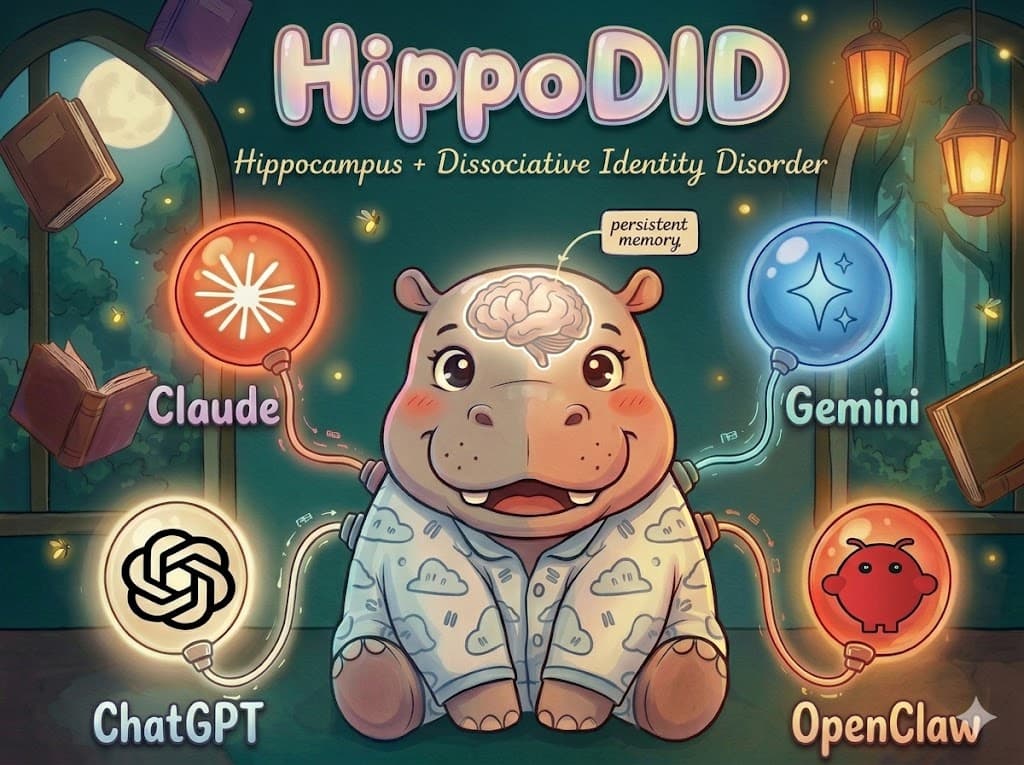
The Problem
Why your AI agents keep forgetting.
Problem 01
AI has no long-term memory.
Every new conversation starts from zero. Your agent has no idea what it learned last week, last session, or five minutes ago if you switched tabs.
HippoDid gives each agent a persistent character — memories survive across sessions, restarts, and model upgrades.
Problem 02
Your MEMORY.md gets compacted away.
You've been building a MEMORY.md — carefully curated context. Then the context window fills up, the AI compacts it, and half your knowledge disappears.
hippodid sync pushes your memory files server-side. Compaction-safe. Your MEMORY.md is a live backup, not a liability.
Problem 03
Different AI models can't share context.
You use Claude for coding, GPT-4 for writing, and Gemini for research. Each one thinks it's meeting you for the first time — every time.
One HippoDid character, all your models. Memory is model-agnostic — stored as text, searchable by any client that speaks REST or MCP.
How it works
Three steps to
memory that lasts.
No vector database setup. No embeddings infrastructure. HippoDid handles the plumbing — you write the logic.
Create a character
A character is a named memory store — think of it as your agent's long-term brain. Create one per AI persona, project, or use case.
POST /v1/characters{"name": "My Coding Agent","categoryPreset": "developer"}
Connect your tool
Add HippoDid to whatever you're already using. Two-line config for Spring Boot, one JSON block for Claude Desktop or Cursor.
hippodid:api-key: ${HIPPODID_API_KEY}character-id: ${CHARACTER_ID}
Your AI remembers
Memories persist on the server. Search returns semantically ranked results. Your AI starts every new conversation where the last one ended.
// Every new session:List<MemoryResult> ctx = hippodid.characters("agent").search(query, opts).memories(); // ranked by relevance
Memory modes
Two memory modes.
Pick what fits your workload.
VERBATIM
Highest recall over raw conversation history, with fast writes and no AI cost to ingest. Best for: chat history, support logs, “what exactly did the user say.”
Independently benchmarked at 77.8% on LongMemEval-S — see how that compares and how we measured it.
See the benchmark →EXTRACTED
Structured knowledge: entities, relationships, deduplicated facts, automatic decay. Best for: knowledge graphs, entity resolution, cross-session consolidation, “how do these things relate.”
Developer SDKs
10 lines of code.
Any framework.
Install with one command. Call assemble_context() and get a ready-to-use prompt with your character's profile and relevant memories.
pip install hippodidnpm install @hippodid/sdkdev.hippodid:hippodid-spring-boot-starter:1.2.0from hippodid import HippoDidhd = HippoDid(api_key="hd_...")ctx = hd.assemble_context(character_id="agent-uuid",query="What does the user prefer?",strategy="conversational",)# ctx.formatted_prompt → ready for any LLMresponse = llm.chat(ctx.formatted_prompt)
Works with every framework
Pricing
Transparent pricing.
No AI markup.
All AI features require your own API key — you pay your AI provider directly at their published rates. We don't charge for AI compute. We charge for infrastructure.
BYOK (Bring Your Own Key) — You configure your own OpenAI, Anthropic, or compatible endpoint. You see costs in your provider dashboard. We never see your data sent to AI.
No credit card. No expiry.
- 3 characters
- 100 memories/char
- AI extraction (BYOK)
- Semantic search (5 results)
- Document import (≤50 KB)
- 1 synced file (≤50 KB)
- 1 API key
- BYOK config
Solo developers & personal agents.
- 10 characters
- 1,000 memories/char
- All Free features
- Direct memory write
- Character profiles & aliases
- Playground
- 5 synced files (≤500 KB)
- Import (≤50 KB)
Serious agents. Production use.
- 100 characters
- 10,000 memories/char
- Team sharing (3 members)
- Unlimited import
- Custom category decay
- 20 synced files (≤2 MB)
- 3 API keys
- Auto-capture / recall
- Smart retrieval
Teams building AI products.
- 500 characters
- 25,000 memories/char
- Team of 10
- Webhooks
- Batch ops
- Full audit trail
- 100 synced files (≤10 MB)
- 10 API keys
- Priority support
Dedicated infra, SLA, priority support.
- Unlimited characters
- Unlimited memories/char
- File sync
- Unlimited API keys
- Custom sync interval
- AI extraction
- Webhooks & audit trail
- SSO / SAML
- Dedicated support
Annual billing saves 20%. Downgrades take effect at end of billing period.
Comparison
HippoDid vs Mem0
— straight talk.
Mem0 is good. HippoDid is built specifically for developers who value local-first principles, transparent pricing, and Java-native tooling.
| Feature | HippoDid from $0/mo | Mem0from $19/mo (graph: $249) |
|---|---|---|
Local file sync (MEMORY.md) Your memory, in your files, on your machine | Yes | No |
Import existing memory Import .md and .txt files via API or MCP tool | Yes | No |
Structured memory at scale Category presets, salience scores, time decay | $19/mo | $249/mo |
Genuine free tier No API key required, no credit card, file sync works | Yes | No |
Spring Boot native starter 2-line configuration, @Autowired HippoDidClient | Yes | No |
MCP (Model Context Protocol) Claude Desktop, Cursor, any MCP client | Yes | Yes |
Open-source SDK Apache 2.0, Maven Central | Yes | No |
Compaction-safe memory Files survive context window limits | Yes | No |
BYOK AI (your key, your cost) Pay your AI provider directly, no markup | Yes | Partial |
OpenAPI spec + docs Interactive Redoc, full endpoint reference | Yes | Yes |
Built for developers
Serious infrastructure.
No surprises.
HippoDid runs in production. These are the details that matter when you're building something real.
Built for Java & Spring developers
Not an afterthought port. HippoDid was designed from the ground up for JVM developers — Spring Boot auto-configuration, Maven Central distribution, idiomatic Java Records.
Open-source SDK
The Spring Boot starter is Apache 2.0. Read the source, fork it, contribute. No black box, no vendor lock-in for your client code. The server is proprietary — the SDK is yours.
Full OpenAPI spec + Redoc docs
Every endpoint documented. Interactive Redoc UI at docs.hippodid.com. Machine-readable spec you can import into Postman, generate a client, or validate against.
21 MCP tools out of the box
Claude Code, Claude Desktop, Cursor, OpenClaw — configure once with a single JSON block. Hosted mode (SSE, zero install) or local mode (stdio, file watching). All tools work immediately.
Works with
About
Built by a real human.
Not a faceless API.
HippoDid asks for your API keys. You deserve to know who's behind it.
Yang Jing
SameThoughts Inc.
Most AI memory products treat memory as a flat list of facts bolted onto a chatbot. Yang Jing thinks that's the wrong foundation. HippoDid is built on a different premise: agents need identity — structured, multi-tenant, durable memory that survives sessions and scales across teams — not just retrieval. That conviction comes from 20+ years building enterprise systems where data integrity was the whole job, including 7 years at Salesforce leading the CPQ pricing and configuration engine for Fortune 500 customers. He builds HippoDid solo, in Java, with the architectural rigor that domain demanded — because memory infrastructure that agents will depend on shouldn't be built any other way.
Frequently asked questions
Everything you need to know about giving your AI agents persistent memory.